The Ten Lost Tribes: The History and Mystery of the Lost Tribes of Israel by Charles River Editors
Author:Charles River Editors
Language: eng
Format: mobi, epub
Publisher: Charles River Editors
Published: 2014-09-18T07:00:00+00:00
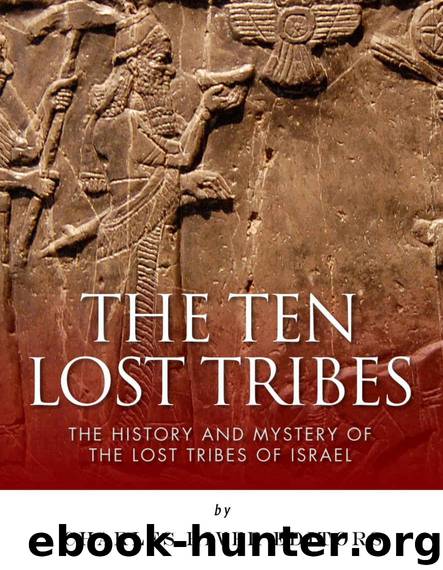
A relief depicting Sargon II meeting with a foreign dignitary
When he finally managed to follow up on the western front, where Shalmaneser V had left off, Samaria and many surrounding cities had easily succeeded in sloughing off Assyrian rule. However, Sargon II wasted no time in recapturing the cities Shalmaneser V had captured, and he managed to regain control of Samaria by the spring of 719 BCE.
The events of Samaria’s fall were chronicled in the Assyrian annals from the reign of Sargon II and the Old Testament, and although the two sources present the event from different perspectives, they corroborate each other for the most part and together present a reliable account of the situation. The Assyrian record reads, “I besieged and conquered Samaria (Sa-me-ri-na), led away as booty 27,290 inhabitants of it. I formed from among them a contingent of 50 chariots and made remaining (inhabitants) assume their (social) positions. I installed over them an officer of mine and imposed upon them the tribute of the former king. Hanno, king of Gaza and also Sib’e, the turtan of Egypt (Mu-ṣu-ri), set out from Rapihu against me to deliver a decisive battle. I defeated them; Sib’e ran away, afraid when he (only) heard the noise of my (approaching) army, and has not been seen again. Hanno, I captured personally. I received tribute from Pir’u of Musuru, from Samsi, queen of Arabia (and) It’amar the Sabaen, gold in dust-form, horses (and) camels.” (Oppenheim 1992, 284-5).
A second inscription records more details about the fate of the population: “[The inhabitants of Sa]maria, who agreed [and plotted] with a king [hostile to] me, not to endure servitude and not to bring tribute to Assur and who did battle, I fought against them with the power of the great gods, my lords. I counted as spoil 27,280 people, together with their chariots, and gods, in whom they trusted. I formed a unit with 200 of [their] chariots for my royal force. I settled the rest of them in the midst of Assyria. I repopulated Samaria more than before. I brought into it people from countries conquered by my hands. I appointed my commissioner as governor over them, and I counted them as Assyrians.” (Nimrud Prism, lines 25-41).
The Assyrian accounts reveal that others in the region, namely the Egyptians, were involved on Israel’s side to a certain extent, but it is uncertain how many troops were sent with Sib’e because this account cannot be corroborated by any Egyptian source. Perhaps the most striking piece of information is that nearly 30,000 Israelites were removed from the region; the forced removal of rebellious populations by the Assyrians was a brutal but effective tactic that they commonly used (and is discussed more thoroughly below).
The Biblical account of the fall of Samaria is quite similar to the Assyrian, but with a few minor differences. For example, the Biblical text adds a comment regarding where Sargon II deported these inhabitants: “And it came to pass in the fourth year of king
Download
The Ten Lost Tribes: The History and Mystery of the Lost Tribes of Israel by Charles River Editors.epub
This site does not store any files on its server. We only index and link to content provided by other sites. Please contact the content providers to delete copyright contents if any and email us, we'll remove relevant links or contents immediately.
| Africa | Americas |
| Arctic & Antarctica | Asia |
| Australia & Oceania | Europe |
| Middle East | Russia |
| United States | World |
| Ancient Civilizations | Military |
| Historical Study & Educational Resources |
The Daily Stoic by Holiday Ryan & Hanselman Stephen(3365)
The Fate of Rome: Climate, Disease, and the End of an Empire (The Princeton History of the Ancient World) by Kyle Harper(3091)
People of the Earth: An Introduction to World Prehistory by Dr. Brian Fagan & Nadia Durrani(2760)
Babylon's Ark by Lawrence Anthony(2722)
Ancient Worlds by Michael Scott(2721)
The Daily Stoic by Ryan Holiday & Stephen Hanselman(2710)
India's Ancient Past by R.S. Sharma(2493)
Foreign Devils on the Silk Road: The Search for the Lost Treasures of Central Asia by Peter Hopkirk(2482)
MOSES THE EGYPTIAN by Jan Assmann(2454)
The Complete Dead Sea Scrolls in English (7th Edition) (Penguin Classics) by Geza Vermes(2313)
The Earth Chronicles Handbook by Zecharia Sitchin(2260)
Lost Technologies of Ancient Egypt by Christopher Dunn(2255)
24 Hours in Ancient Rome by Philip Matyszak(2101)
Alexander the Great by Philip Freeman(2087)
Aztec by Gary Jennings(2061)
The Nine Waves of Creation by Carl Johan Calleman(1937)
Curse Tablets and Binding Spells from the Ancient World by Gager John G.;(1884)
Before Atlantis by Frank Joseph(1880)
Earthmare: The Lost Book of Wars by Cergat(1843)
